


With Two Awards and Some Stellar Students, Researcher Polishes New, Highly Flexible Technology
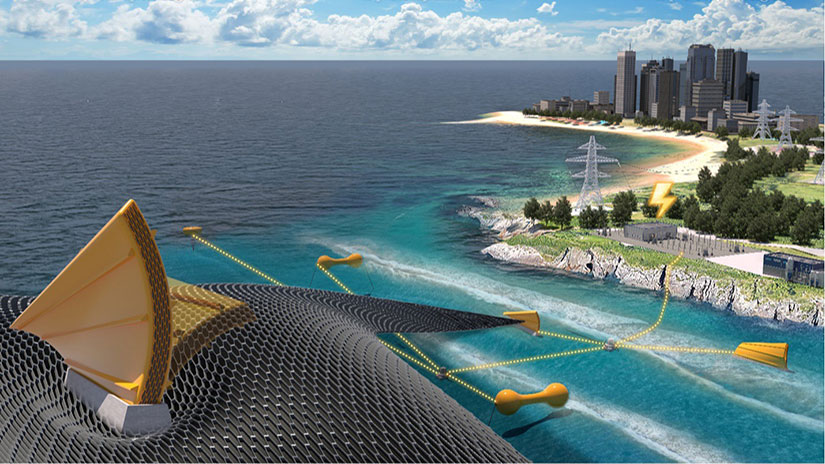
Blake Boren had a few questions about the flexible flap.
Like, how big should the flap be? What is the optimal flap shape? And what is the best way to build a flexible flap?
“I guess a more technical term is a bottom-fixed surging flexible wave energy converter,” said Boren, a senior engineer at the National Renewable Energy Laboratory (NREL). “But it’s really just a flexible flap.”
After all that, you might have a few questions of your own. Keep reading; we have answers.
In 2020, Boren earned funding from the U.S. Department of Energy’s Water Power Technologies Office (WPTO), through its Seedlings and Saplings program for national laboratory researchers, to hone a new and unusual kind of technological domain. Boren and colleague Jochem Weber called it distributed embedded energy converter technologies, or DEEC-Tec for short. With DEEC-Tec, ocean wave energy technology developers can interweave small individual generators into devices—or metamaterials, as Boren calls them—of almost any size or shape. Such materials can bend, twist, or even stretch in ocean waves to harness that rambunctious energy in an entirely new way.
One shape these metamaterials could take is a flexible flap (that bottom-fixed surging flexible wave energy converter thing). The flexible flap is basically a rectangular paddle, mounted on the seafloor, that can twist and dance in the waves.
But even though Boren’s DEEC-Tec just earned its first patent, he has plenty of questions to explore before flexible flaps—or flexible tubes, balloons, and any other DEEC-Tec-based ocean wave energy converter—can hit the water. Questions such as how to best distribute and embed these energy converters to make the technology viable.
WPTO awarded Boren two seedling awards, so he and a group of curious students and researchers could search for answers. The small $50,000 seed grants are designed to support this exact kind of creative exploration with a grand goal of supercharging water power research. Marine energy devices, like Boren’s DEEC-Tec-based machines, could eventually help support the country’s clean energy and decarbonization efforts.
For his first seedling project, Boren brought in a precocious graduate student from Virginia Tech, Wendelle Sparrer.
“Wendelle was fantastic,” Boren said.
Sparrer set out to build a model that could simulate how various flexible flap designs might affect performance; her goal was to identify which shape, like a triangle or rectangle, could capture the most energy from ocean waves. To do that, Sparrer used a software tool called StarCCM+. But she quickly realized that no matter which shape she chose, when fluids like ocean waves interacted with the flexible device, their movement was too complex and erratic to fully capture in a model. She needed a virtual wave tank to toss her virtual flexible flaps into to see how each might respond to actual ocean waves.
But the software tool did not have a virtual wave tank. So, she built one herself.
“That was actually a pretty big accomplishment, even though it wasn’t the primary motivation of the codesign seedling project,” Boren said. “It was, nonetheless, a necessary building block and a pretty impressive accomplishment.”
Although Sparrer didn’t find an optimal shape for the flexible flap (or, as Boren put it, “she didn’t find the bee’s knees geometry”), her work uncovered critical gaps in numerical tools that could hinder DEEC-Tec-based ocean wave energy technology development.
“It’s no easy lift, right?” Boren said. “We could have been very naive in suggesting that a seedling project would be sufficient. This is clearly promising research, but it’s going to take a lot more effort to flesh out.”
Boren’s second seedling project could, at the very least, help promote the new tech (and maybe even drum up some much-needed funding). For what he called his prototype seedling, Boren brought in a team of students and early-stage researchers to experiment with DEEC-Tec, construct and evaluate prototypes, and recreate the technologies in animations or virtual simulations.
“The DEEC-Tec domain is so inherently large,” Boren said. “Not only do we need funding to further develop the domain, but we also need a much broader range of skill sets than what is normally found within the marine renewable energy community. To that end, a $50,000 DEEC-Tec prototype seedling matched with a diverse group of students and early-state researchers was a natural fit.”
For one project, the students built rigs over which they stretched an acrylic skin—a way to imitate one type of small DEEC-Tec generator, called a dielectric elastomer generator. They also experimented with how to embed the DEEC-Tec generators together, wrote programming to control those woven devices, and created simulations to analyze the physics behind these metamaterials (using a software package called COMSOL).
“The prototype seedling has been very effective,” Boren said. After the team published explanatory animations and other outreach materials, Boren said he saw an increase in interest in DEEC-Tec. “It’s like a trickle-down effect,” he said.
That extra attention also helped launch a new prize, called InDEEP, which stands for Innovating Distributed Embedded Energy Prize. The prize, which recently announced its Phase I winners, encourages an even wider pool of creative minds—including students, researchers, and entrepreneurs—to explore DEEC-Tec’s potential.
That potential also includes origami.
With his last bit of seedling funding, Boren is pursuing his own creative idea: an origami wave energy converter built from DEEC-Tec. The device could, for example, fold into one or more smaller packages to make it easier to transport and deploy. If, for example, a natural disaster knocks out power to a community, they could quickly ship in a DEEC-Tec-based backup generator. (A grid might go dark, but the ocean will never stop churning.)
An origami wave energy device could also protect itself from extreme waves, folding like a pill bug or roly-poly, to shield that dangerous energy. And if one of those small generators fails or sustains damage, the others can continue generating energy, so operators don’t need to rush out to perform repairs or lose precious income while a device is down.
Meanwhile, Boren will continue to refine DEEC-Tec alongside a growing number of aficionados. “Ultimately,” Boren said, “we hope to answer that original question: ‘Are there optimal shapes for DEEC-Tec-based ocean wave energy converters, like flexible flaps?’”
Now, thanks to the seedling projects, Boren has the seeds to help grow an answer.
Want more metamaterials? Check out DEEC-Tec’s cousin, hexDEEC, which could potentially be used to build energy-generating roads, fabrics, and more. And subscribe to the NREL water power newsletter, The Current, to make sure you don’t miss a water power update.
